Virtual Receptionist Australia vs United States: Which Option Actually Works for Your Business?
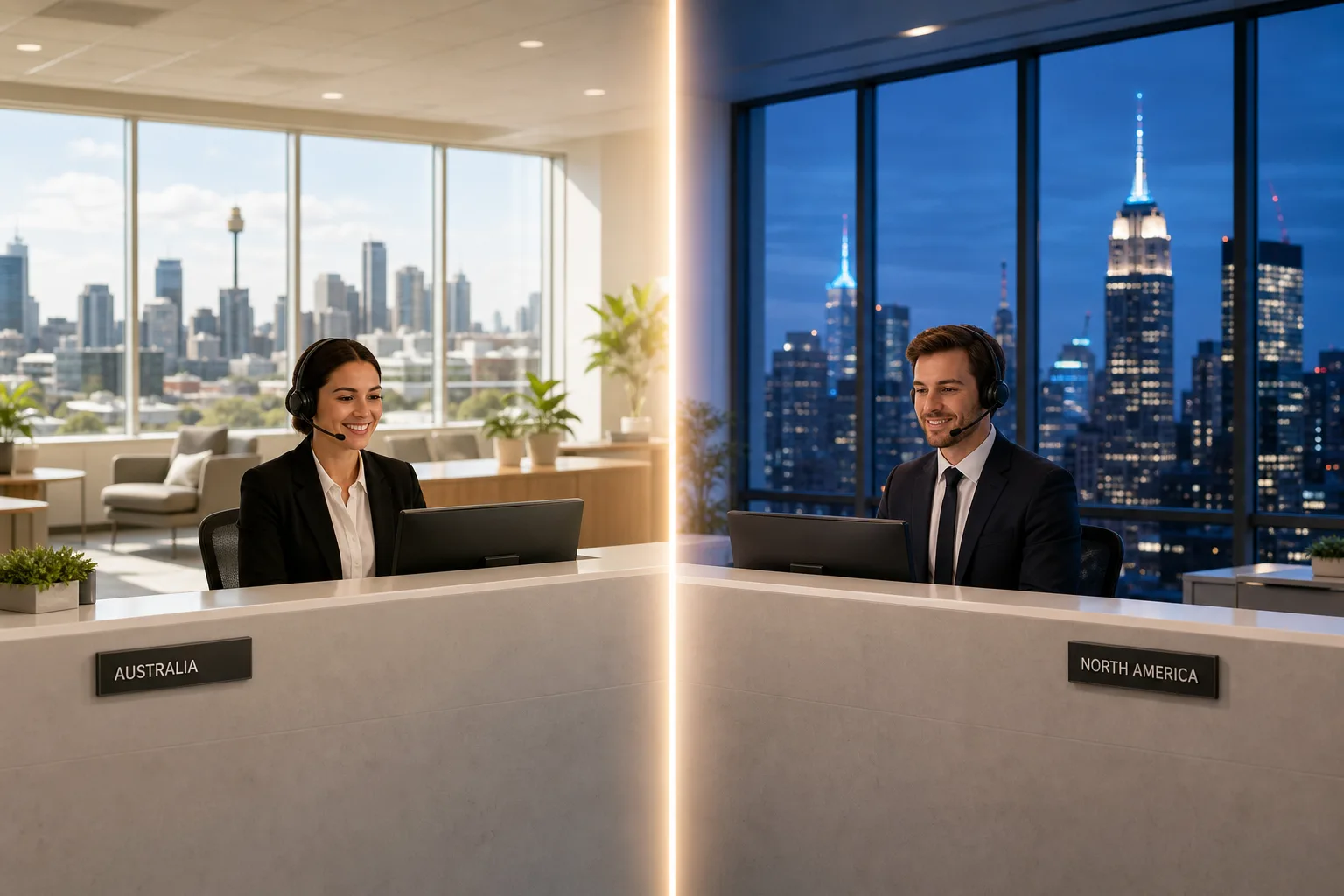
Australian human staff, United States-based offshore services, and AI-native platforms differ on timezone fit, data residency, and cost. Those three variables decide which model works for your business, not the headline price.
Key takeaways: Australian services suit business-hours callers who value local accent and data staying onshore. United States services carry timezone gaps and data-sovereignty risks that most buyers underestimate. AI platforms resolve the timezone problem entirely and typically cost less at volume. Data residency is your first filter if you work in healthcare, finance, or law.
What the Australia vs United States Comparison Actually Means in 2025
The Australia vs United States comparison in 2025 is really a three-way choice: local human staff, offshore human staff, or AI-native platforms. The deciding factors are timezone overlap, cultural fit, and which country's privacy law governs your call data.
The three models buyers are really choosing between
- Australian human services: Local staff, strong cultural fit, business-hours coverage, higher per-call cost
- United States human services: Larger staff pools, potential overnight coverage from their perspective, significant timezone mismatch for Australian business hours, lower headline cost
- AI-native platforms: Available around the clock, no timezone dependency, flat-rate subscription pricing, consistent voice and tone every call
Most competitor comparison pages treat AI as a footnote. It isn't. For a growing number of Australian SMBs, it's the primary option worth evaluating.
Why location still matters even in a cloud-first world
Location matters because the humans on the other end of your calls are still physically somewhere. That place determines when they're awake, what cultural references they share with your callers, and which country's laws govern how your call data is stored and used.
How Australian-Based Human Virtual Receptionist Services Work
An Australian-based human virtual receptionist service uses locally employed staff to answer calls during AEST/AEDT business hours.
Australian human virtual receptionist services employ local staff who answer calls during business hours, typically on Australian Eastern, Central, or Western time. The core appeal is straightforward: your callers get someone who speaks the same way they do, understands local business norms, and can navigate Australian-specific references without confusion.
Staffing, hours, and timezone coverage
Most Australian services operate during standard business hours, with some extending to early evenings. True 24/7 coverage from Australian-based human staff is rare and significantly more expensive when it exists, because overnight shifts require additional rostering and penalty rates under Australian employment law.
Some providers maintain the majority of their workforce in a single region. According to OfficeHQ, approximately 90% of their team is based on the Sunshine Coast. That kind of geographic concentration can create risk during local disruptions, but it also makes quality control and training more consistent.
If your business receives calls outside standard business hours, confirm explicitly whether an Australian human service covers those times with local staff, forwarded calls, or no coverage at all.
What local knowledge actually delivers for callers
A local receptionist knows what a tradie means by 'a rough quote', understands why a medical patient asking about a Medicare rebate is a routine question, and can pronounce Australian suburb names correctly. These small things add up to trust. For businesses where first-call impression matters, accent and cultural fluency are genuine factors, not soft ones.
Typical pricing structure and what drives the cost
Australian human services typically bill per call or per minute, sometimes with a monthly plan that bundles a set number of calls before overage rates apply. The cost reflects real labour: penalty rates, superannuation, training, and rostering overhead all flow through to the per-call price. For businesses with unpredictable or high call volumes, this can make monthly costs difficult to forecast.
How United States-Based Virtual Receptionist Services Work
United States-based virtual receptionist services are often marketed to Australian businesses on price. Their cost structure can look attractive at first glance, partly because United States labour costs and employment overheads differ significantly from Australian ones. But the trade-offs are real and worth understanding before you sign up.
Where the timezone advantage ends and the problems begin
When you're weighing virtual receptionist Australia vs United States options, the timezone maths matter. A United States East Coast service is roughly 15 hours behind AEST, so their business hours largely overlap with Australian overnight hours. For companies pitching this as a coverage feature, it can sound attractive. In practice, the staff answering your 9am Monday call in Sydney are working a late Sunday evening shift in New York, and turnover in those roles is hard to verify from a distance.
Accent, terminology, and caller trust signals
Australian callers notice when something feels off. A receptionist who pauses at 'arvo', doesn't recognise a suburb name, or says 'zip code' instead of 'postcode' creates friction. For trades businesses, medical practices, and real estate agencies, where the caller is already stressed or making a high-stakes decision, that friction can cost you the booking.
A call where the caller loses confidence mid-conversation and hangs up has the same outcome as a missed call.
Data handling across international borders
This is the issue most comparison guides skip, and it matters most in healthcare, financial services, and any industry handling sensitive customer information. When you route calls to a United States-based service, your call recordings, customer details, and conversation transcripts are processed and stored on United States servers under United States law.
Australian businesses handling personal information are subject to the Australian Privacy Act 1988 and the Australian Privacy Principles. Sending personal information offshore triggers obligations under APP 8, which requires you to take reasonable steps to ensure the overseas recipient handles the data consistently with Australian standards. If you can't verify where call data is stored and how long it's retained, you may be carrying compliance risk you haven't priced in. Ask any offshore provider for their data residency documentation before signing.
The Core Trade-Offs: A Side-by-Side Evaluation Framework
Rather than naming specific services, here's a category-level framework you can apply when evaluating any provider. Run your own business through each dimension.
| Dimension | Australian Human | United States Human | AI-Native |
|---|---|---|---|
| Business-hours coverage | Strong | Weaker (timezone gap) | Full 24/7 |
| After-hours coverage | Limited/expensive | Possible but risky | Consistent |
| Cultural and accent fit | High | Variable | Configurable |
| Data residency | Australia | United States servers | Depends on provider |
| Cost predictability | Per-call/per-minute | Per-call/per-minute | Flat subscription |
| Simultaneous call handling | Limited by headcount | Limited by headcount | Unlimited |
To make this concrete: a plumbing business taking 60 calls a week needs after-hours coverage for emergencies. A medical clinic booking appointments needs data handled under Australian privacy law. A real estate agency fielding weekend enquiries needs consistent coverage on Saturday mornings. None of these scenarios fits neatly into 'just pick the cheapest option'.
Where AI Virtual Receptionists Change the Equation
AI-native call handling is worth treating as its own category, not as a budget substitute for human services. The difference between AI and human virtual receptionist services in Australia comes down to a fundamentally different operating model, not just cost.

What AI-native call handling looks like in practice
An AI receptionist answers every phone call immediately, with a consistent voice and conversation flow configured for your business: handling appointment bookings, lead qualification, and routine enquiries without any rostering.
That specificity matters. A voice agent configured for a dental practice handles calls very differently from a generic one. See how AI receptionists work in Australia for a practical breakdown of what setup involves.
How AI resolves the timezone and staffing constraints
The Australia-vs-United States timezone problem disappears entirely with AI. There's no staff roster to manage, no overnight shift to fill, and no coverage gap when a receptionist calls in sick. Every call gets the same quality of response at 2pm on a Tuesday or 11pm on a Sunday. For businesses in trades or home services where after-hours emergency bookings are part of the revenue model, this consistency is genuinely valuable.
Australian industry analysis suggests AI is typically 5 to 10 times cheaper than a comparable human virtual receptionist service for similar functional coverage, and the gap widens when you account for 24/7 coverage.
Flat-rate pricing vs per-minute billing at scale
Per-minute and per-call billing can look economical at low volumes, but costs grow in direct proportion to call volume. A flat-rate subscription costs the same whether you receive 50 calls or 500 in a month. For businesses with variable or seasonal call volumes, that predictability changes how you budget. Visit Callacy's pricing page for a concrete example of how subscription-based AI receptionist pricing is structured.
Which Industries Benefit Most From Each Model
Trades and home services suit AI for after-hours volume. Healthcare and allied health require Australian data residency regardless of model. Real estate fits AI for weekend and after-hours enquiry clusters. Australian human services work well for any industry whose calls fall strictly within AEST business hours.
Trades and home services
A plumber or electrician misses a call at 7am because they're on a job site. That caller probably tries one or two other numbers immediately. The failure cost is the whole job. For plumbing businesses and electricians, AI handles volume spikes during business hours and genuine emergencies at night without any additional cost per call. Australian human services can work well here during business hours but tend to gap out at exactly the times emergency trades calls come in. United States services add the cultural friction risk on top of timezone complexity.
Healthcare and allied health
For a dental practice, physiotherapy clinic, or podiatry practice, the stakes around data handling are high. Patient information is sensitive. The Australian Privacy Act obligations around health records are stricter than for general business data. An offshore service storing call recordings on United States servers creates a compliance exposure that most clinic owners haven't thought through. For healthcare, data residency is a selection criterion, not an afterthought.
AI platforms with Australian data hosting, combined with appointment booking integration, suit this sector well. Human Australian services work too, but only if they can confirm AEST coverage during clinic opening hours and have clear data handling policies.
Real estate and property management
Real estate enquiries cluster on weekends and after hours, right when most Australian human services are closed or running on skeleton coverage. United States services might cover those clock hours, but cultural and terminology gaps can make the conversation feel off to an Australian caller weighing up a significant financial decision. Consistent, well-configured AI coverage is often the strongest fit for this sector.
Red Flags to Watch for When Evaluating Any Virtual Receptionist Service
Before you sign any contract, run through this checklist when comparing virtual receptionist Australia vs United States or AI options. These questions reveal whether a service will actually deliver what it promises.
- Where is my call data stored? Get a written answer specifying call recordings and transcripts, not a vague assurance.
- What are the overage charges? Low base rates with steep per-call fees once you exceed included volume can make a plan far more expensive than it looks.
- Does 24/7 coverage mean human staff or an automated message? These are very different things.
- What happens when two calls come in simultaneously? Find out what callers hear when all operators are busy.
- What does onboarding actually involve? AI platforms should offer industry-specific templates that reduce setup time significantly compared to human services.
- Is there an escalation protocol for urgent calls? Any service handling trades, medical, or emergency-adjacent calls needs a clear escalation path.
- What's the minimum contract term and cancellation policy? A service confident in its product offers flexibility.
If you're evaluating AI options specifically, the common mistakes in AI call handling for small Australian businesses are worth reading before you commit to any configuration.
Making Your Decision: A Simple Framework for Australian SMBs
Here's how to self-qualify on the virtual receptionist Australia vs United States decision without needing a sales call from anyone.
- If your calls are mostly business hours and brand voice is everything: An Australian human service may suit, provided you've confirmed their actual coverage hours and data policies.
- If overnight or weekend coverage matters and budget predictability is a priority: AI-native is the stronger structural fit. The flat subscription model and 24/7 availability resolve both problems at once.
- If you handle sensitive customer data (health, financial, legal): Data residency is your first filter. Confirm where call recordings are stored before comparing anything else.
- If you're tempted by a lower-cost United States service: Get written answers to the data sovereignty questions first, test a real call for accent and terminology fit, and calculate what the overage structure costs at your actual call volume.
For most small Australian service businesses taking more than 30 calls a week, the case for AI receptionist coverage in Australia gets stronger as call volume grows, because the per-call cost of human services scales linearly while a flat subscription does not.
Frequently asked questions
What is the difference between an Australian and a United States-based virtual receptionist service?
The main differences are timezone alignment, cultural and accent fit, data storage location, and cost structure. Australian services use local staff working AEST/AEDT hours, which aligns with your callers but limits after-hours coverage. United States services have different timezone overlap, which creates coverage gaps during Australian business hours and potential cultural friction for callers. Both typically bill per call or per minute.
Where is my call data stored if I use a United States virtual receptionist service?
Call recordings and customer data handled by a United States-based service are generally processed and stored on United States servers, under United States law. Australian businesses have obligations under the Australian Privacy Act 1988 and APP 8 when transferring personal information offshore. Before using any overseas service, request written documentation of where data is stored, how long it's retained, and what access controls apply.
Can a virtual receptionist service cover my calls 24/7 without using offshore staff?
Australian human services rarely offer true 24/7 coverage with local staff, because overnight rostering under Australian employment law is expensive. AI-native platforms provide genuine 24/7 coverage without any staffing dependency, handling calls consistently at 2am the same way they handle calls at 10am. That's the structural advantage AI has over both Australian and United States human services for around-the-clock coverage.
Is an AI receptionist better than a human virtual receptionist for a small Australian business?
It depends on your call volume, industry, and what callers need. For businesses where cultural nuance and relationship-building matter and call volume is low, a local human service can work well. For businesses with variable or high call volumes, after-hours calls, or sensitivity around data residency, AI tends to be the stronger fit. Australian industry analysis suggests AI costs 5 to 10 times less than comparable human virtual receptionist coverage for similar functional scope.
Do United States-based receptionists understand Australian business culture and terminology?
In practice, many don't. Australian callers use terms, suburb names, and cultural references that aren't familiar to United States staff. For trades, medical, and real estate businesses where first-call trust matters, this creates friction that can result in lost bookings. It's worth running a test call to assess how a United States service handles your specific business context before committing.
How quickly does a virtual receptionist typically answer calls?
Response speed varies significantly by model. Some Australian human services pick up within 3 rings on the majority of calls. AI systems answer immediately every time, with no queue. The speed difference matters: industry research shows that a 5-minute response time produces 8 times higher conversion compared to a 1-hour delay, so any gap in coverage is a real revenue risk.